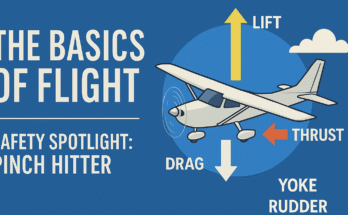
Original Article Credit: Safety Spotlight – Pinch Hitter
Flight Deck Controls ✈️
The flight deck is the command center of an aircraft. Depending on the type of airplane, you may see classic steam gauges—individual round dials—or a modern glass cockpit with digital screens that combine multiple readings. These instruments provide essential information about speed, altitude, position, and engine performance. When you fly, ask your pilot to walk you through the instruments in that particular aircraft.
Primary Flight Instruments
- Airspeed Indicator – Like a car’s speedometer, but measured in knots. Example reading: 122 knots or 116–117 knots.
- Attitude Indicator – Also called the artificial horizon, it shows pitch (nose up/down) and bank (left/right tilt) relative to the horizon. Example: Level flight.
- Altimeter – Displays height above mean sea level (MSL). Examples: 3,000 feet MSL or 5,500 feet MSL.
- Heading Indicator – Shows the direction the aircraft is pointing. Examples: 150° or 89°.
- Vertical Speed Indicator (VSI) – Measures climb or descent rate in feet per minute. A comfortable range is typically 500–1,000 fpm. Examples: 0 fpm descent or 0 fpm.
- Tachometer – Indicates engine power in revolutions per minute (rpm). Examples: 2600 rpm or 2630 rpm.
- Fuel Gauges – Show the fuel quantity in each tank. Most small aircraft have one tank per wing. Examples: 11 gallons (left), 12 gallons (right) or about 13 gallons in each tank.
Aviation English: Common Terms
- MSL (Mean Sea Level) – Altitude measured above sea level, shown on the altimeter.
- AGL (Above Ground Level) – Distance from the aircraft to the ground below, calculated from MSL minus terrain elevation.
- Knots – A unit of speed used in aviation. 100 knots = 100 nautical miles per hour ≈ 115 mph.
Flying by Rules: VFR vs IFR
- VFR (Visual Flight Rules) – Flying with reference to the outside horizon; fair-weather flying.
- IFR (Instrument Flight Rules) – Flying primarily by instruments, following specific procedures and ATC guidance, often used in cloudy or low-visibility conditions.
- VMC (Visual Meteorological Conditions) – Weather conditions clear enough for visual flying. Often used interchangeably with VFR.
- IMC (Instrument Meteorological Conditions) – Low visibility or cloud flying conditions, requiring reliance on instruments and IFR procedures.
Radio and Transponder Basics
Communication with air traffic control (ATC) and other aircraft is done via radio and transponder. When speaking on the radio, the rule is simple: who you’re calling, who you are, and what you want. In an emergency, just speak clearly and normally. If not already on a frequency, use 121.5 MHz, the international emergency frequency.
Radios require turn-taking—if two pilots talk at once, both transmissions are blocked. Don’t hesitate to ask your pilot to demonstrate the radio, and you might even try making a call yourself!
The transponder sends identifying codes to ATC radar. With ADS-B technology, nearby equipped aircraft can also see your position. Common codes include 1200 (normal VFR operations) and 7700 (emergencies). Ask your pilot if you can enter a code on your next flight.
The Four Ws of Communication
Before pressing the mic button, remember the Four Ws: Who you’re calling, Who you are, Where you are, and What you want. Clear and concise communication improves both safety and efficiency, whether at a nontowered airport or talking with ATC.
✍️ Professional rewrite by [Your Name], with full credit to the original article owner: Safety Spotlight – Pinch Hitter